 Twice Told
Taejo, Pak Sun and the envoys to Hamhung
In 1687 an official told the king a family's story about Pak Sun and King Taejo was not the fact of the time. The Sillok has Pak Sun killed in a rebel army.
Contents
Published 15 Oct 2026. Sources checked 10 Oct 2026.
In Korean, hamhung chasa, “the envoy sent to Hamhung”, means someone who goes away and is never heard from again.6 In the first month of 1687 the inspector-general Yi Seon asked King Sukjong to take back an honour he had given the year before.7 The honour was a posthumous name for Pak Sun, an officer killed in the winter of 1402.81 Pak Sun’s descendants said that he had talked the retired King Taejo into coming home, and Yi Seon told the king that this was not the fact of the time.7 Their story is the one behind the saying.
The story is told here as it was collected at Oryu-ri, in Eumseong county, and printed in 1982.9
After Taejong took the throne, King Taejo went to Hamhung, his home, and took the royal seal with him.9 Taejong sent envoys nine times to ask him back, and Taejo killed every one of them, and no minister was willing to go.9 Then Pak Sun, who had served under Yi Seong-gye in the Liaodong campaign of 1388, offered himself.910
In 1402 Pak Sun set out without an envoy’s carriage and without servants, riding a mare with her foal.9 By the river outside Taejo’s lodge he tied the foal to a tree and led the mare in.9 The foal cried outside, Taejo asked what the noise outside was, and Pak Sun said that even a beast could not give up the tie between parent and child.9 Days later a mother mouse fell from the eaves with her young and, hurt as she was, would not let go of them. Pak Sun stopped the guards from killing her, wept, and begged Taejo to go home.9 Taejo promised to come within days.9
The courtiers at the lodge feared what Taejong would do to them, and pressed Taejo to have Pak Sun killed.9 On the third day Taejo told them, “If he has crossed the Yongheung river, let him go; if not, cut him down.”9 Pak Sun was only now boarding the ferry. Soldiers who rode up shouting “By royal order!” cut him down at the waist, half in the boat and half in the water.9 Taejo wept, said he would not betray his friend’s earlier words, and went back to Seoul.9 Taejong made Pak Sun a merit subject, and gave a burial site and rank to his wife, who had killed herself when the news came.9
Chungmin, 1686
The name the court gave Pak Sun in 1686 was Chungmin.8 The chief state councillor Kim Su-hang asked for it in the eleventh month, and the king agreed.8 Kim’s case rested partly on a stele text by Chae Su for Pak Sun’s son Pak Heun, which the family kept as a print.11 As Kim reports it, the text says Pak Sun attended Taejo as a sword-bearer, asked to go in, did not return, and that Taejong grieved, recorded his merit and gave land and people.11 Kim granted that nothing visible showed the recording of merit, and added that Pak Sun’s death at Hamhung under royal orders was very clear.12 We have not seen Chae Su’s text, only Kim’s account of it.
The Pak Sun entry in the Encyclopedia of Korean Culture, by Yi Gyu-cheol, says the story of Pak Sun as the Hamhung envoy first appears in Song Si-yeol’s text for Pak Sun’s wife, and seems to have spread after Min Jeong-jung quoted it in his petition for the posthumous name.13 The same entry says that early official histories and other records do not contain it.14
Yi Seon’s memorial
The Sukjong Sillok records Yi Seon’s memorial.7 It answers the descendants’ claim with the court’s records of Taejo’s trip to Anbyeon in 1401 and of Pak Sun’s mission in 1402.7151
本非其時事實也7
That was not the fact of the time.
By Yi Seon’s account, Taejo went to Anbyeon in the spring of 1401, Seong Seok-rin was sent, and Taejo returned to the palace.15 Pak Sun, he writes, went from the capital to Hamju and told the governor and the magistrates not to follow Cho, and was killed in the army.1 Generals then escorted Taejo by way of Pyongyang to Songdo, and Taejong met him at Geumgyo.4 Cho Sa-ui and more than ten of Taejo’s attendants were executed, and the attendants’ names had still not been cleared.16
Yi Seon wrote that Pak Sun had died carrying out his duty, and that what the descendants claimed on top of that was not the fact of the time.7 The king answered that it should be done as the memorial asked.7 On the 22nd Yi Seon petitioned again, and this time the king did not answer.17 The encyclopedia entry says that controversy arose but the name was left as granted.18 We did not find a Sillok entry that settles it.
The same months in the Taejong Sillok
The Taejong Sillok gives the same months day by day, dated by the lunar calendar.
Trouble starts on the 5th day of the eleventh month of Taejong’s second year, when Cho Sa-ui raised troops.19 He was a kinsman of Queen Kang and meant to avenge her.19 The same day the eunuch Kim Wan came back from Taejo’s lodging and reported that Taejo meant to visit his ancestors’ tombs in the northeast and then tour the Diamond Mountains.20 People would call the trip mad, Taejo said.20
On the 8th the king gave a horse to the magistrate of Hoeyang for reporting that Taejo’s carriage had passed the Cheollyeong pass.21 The first entry for the same day records the death of Pak Sun.1
遣上護軍朴淳于東北面, 被殺于彼軍中。1
The king sent the senior guard general Pak Sun to the northeast, and he was killed in that army.
The entry goes on to say that Pak Sun had reached Hamju and told the circuit commissioner and the magistrates not to follow Cho Sa-ui.1 The entry is two sentences long and names no river, ferry or lodging, no order from Taejo, and not Taejo at all.22 Three days later the Sillok records Song Yu, a guard officer, who had gone to Hamju on orders and was likewise killed by those troops.2
On the 9th Taejo set out for Hamju by post horse, and the king sent the royal preceptor Muhak to ask him to come home quickly.23 On the 18th his carriage turned toward Old Maengju.24 Cho’s army broke up at night on the Sal river near Anju, and several hundred died when the ice broke as they crossed.25 Cho Sa-ui and his son were jailed in Seoul on the 7th of the twelfth month.25 The next day Taejo came back, and the king met him at the Geumgyo post-station.4
In the Sillok, the two envoys who die are killed by the rebel army.12 Neither entry names an order from Taejo.2226
Messengers on the road
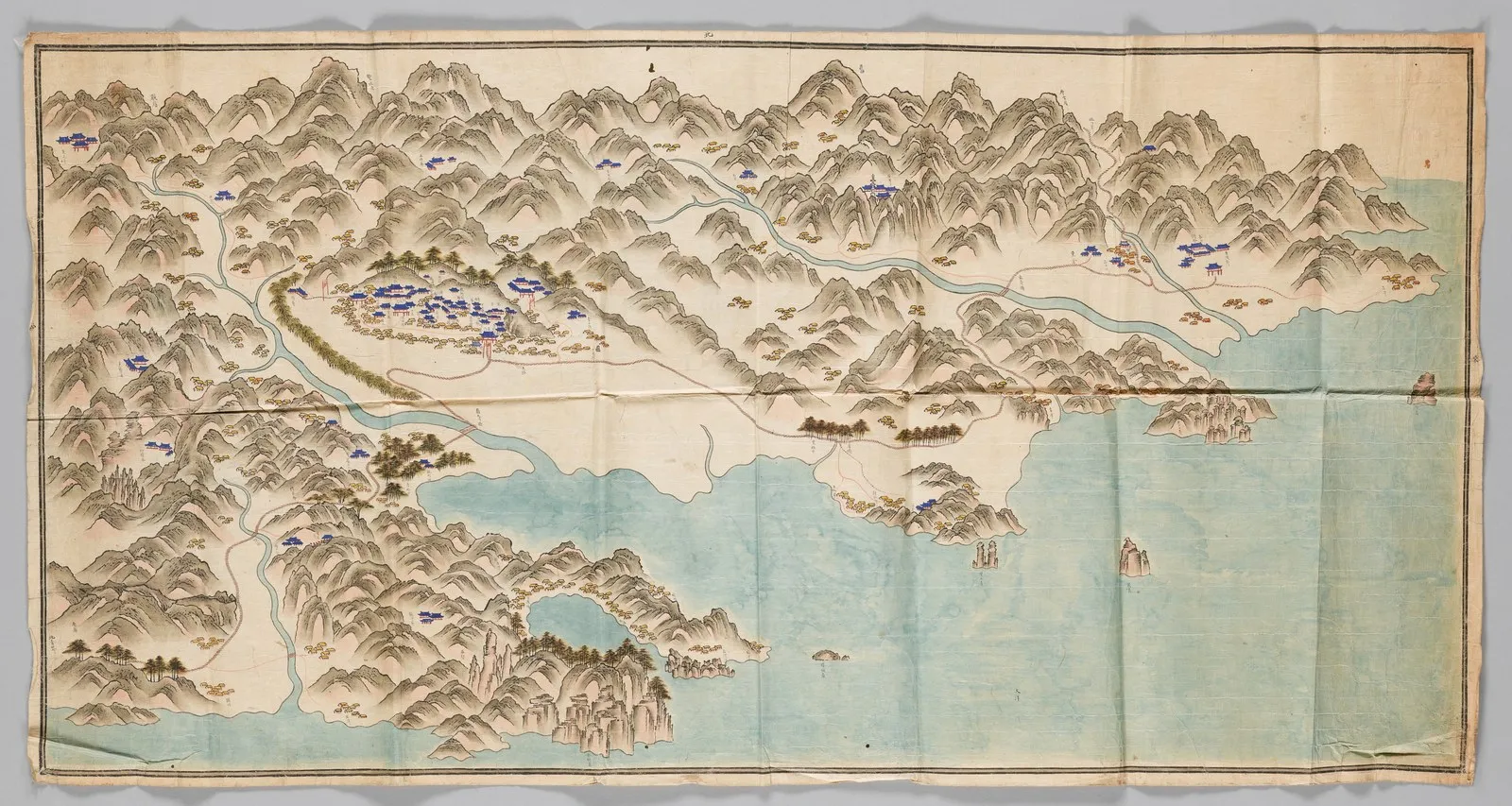
Dancheon map (端川地圖), a Joseon manuscript map of Dancheon county in Hamgyeong province, accession M 146, National Museum of Korea, KOGL Type 1. The map shows another county of the province, not Hamhung or Anbyeon.
In the same weeks the king sent several others to Taejo.20272829 Kim Wan returned on the 5th.20 Sim Jong and Yu Chang were sent to guard the lodging on the 7th, with Yi Jik to ask after him.27 Yi Seo, with the monks Ingnyun and Seoro, was sent on the 15th, and on the 24th Yi Seo and Seoro reached Cheollyeong and turned back because the road was blocked.28 A eunuch, No Hui-bong, went on the 27th, and Yi Seo and Seoro again on the 28th.29
Taejo says as much himself. On the 2nd of the twelfth month, at Pyongyang, he said that the king had sent nobody to him in the northeast or at Maengju.5 An attendant answered that the king had sent Yi Seo and the monks, but the road was blocked.5
予在東北面時, 國王不遣人, 在孟州時, 又不遣人, 不無憾焉。5
“When I was in the northeast the king sent nobody, and when I was at Maengju he sent nobody again. I do feel some resentment.”
An earlier envoy had come back too. In the spring of 1401 Pak Seok-myeong returned from Anbyeon and reported that Taejo had ordered cooling pavilions built at Anbyeon and at Hamju, which suggested he meant to stay long.30 Seong Seok-rin was sent, and Taejo reached Maicheon on the 28th of the fourth month and entered Seoul.15 In the eleventh month he left again at night for Soyosan.31 In the first month of 1402 the king visited him there, and Seong Seok-rin and the royal kin pressed him to return; Taejo said that his love of the Buddha was only for his two sons and a son-in-law.32 When he set out for the northeast in the tenth month, he told guards who objected that they were soldiers he had raised and asked why they betrayed him.33
The Hamhung chasa entry by Kim Seong-jun puts the story of Taejo killing the envoys down to yasa, the unofficial anecdote books.14 It says that in the documents only Pak Sun’s sacrifice is known.34 The Sillok also records a second killing, Song Yu’s.2
Four claims checked
| The story | The record | Verdict |
|---|---|---|
| Taejo sat in Hamhung and would not come home | Set out for Hamju on the 9th, at Pyongyang by the 2nd235 | Unsupported |
| Taejong sent nine envoys, all killed | Two killed in a rebel army; others returned or turned back122028 | Contradicted |
| Taejo ordered him cut down at the ferry | Killed “in that army”; no order named122 | Unsupported |
| Pak Sun’s words brought Taejo home | Yi Seon, 1687: not the fact of the time7 | Disputed |
Whether Taejo came home because of Pak Sun is the point the sources we read do not settle. The Hamhung chasa entry credits another man, the monk Muhak.3 The Taejong Sillok records Muhak being sent on the 9th.23
The Sillok puts the killing “in that army” at Hamju.1 According to the Pak Sun entry, a shrine to him was founded in 1737 at Yeongheung, beside the Yongheung river, where he fell.35 The same entry records that in 1388 he carried Yi Seong-gye’s request to the king to turn the army back, and the Eumseong entry calls the two friends.10
On the 3rd of the twelfth month, the Taejong Sillok says, two officials of Taejo’s own household office, Jeong Yong-su and Sin Hyo-chang, who had followed him north, were jailed for taking part in Cho Sa-ui’s plot.36 Yi Seon writes that Taejo was staying in Cho’s army.24
What we could not verify
Sources we have not seen
- Song Si-yeol’s tomb-marker text for Pak Sun’s wife, in the Songja daejeon. The Pak Sun entry in the Encyclopedia of Korean Culture places the envoy story’s first appearance there. The Korean Classics Database search returned a system error to our requests on 10 October 2026, and no other host we found carried the passage.
- Min Jeong-jung’s petition biography of Pak Sun, in the Nobongjip. The same entry says it spread the story. We found no readable copy online.
Seen only where others quote them
- Chae Su’s stele text for Pak Sun’s son Pak Heun, which we know only through Kim Su-hang’s 1686 statement in the Sukjong Sillok. It may be an older trace of the story than Song Si-yeol’s, and the family’s print is not available to us.
Questions we could not settle
- Whether Taejo knew of Cho Sa-ui’s plot, and where he was between the 9th and the 18th of the eleventh month.
- Whether the posthumous name was withdrawn after Yi Seon’s petitions.
- Whether the monk Muhak ever reached Taejo.
Read next
TaleKumano and Saga, Japan, 219 BCE to 1826
How Xu Fu got to Japan
TaleChina, Tang to Song
Before Xuanzong's dream, Zhong Kui was already a name
TaleKyoto and Obama (Wakasa), Japan, 1449 to 1764
Yao Bikuni, the nun shown in Kyoto in 1449
Sources
- Taejong Sillok, sillok.history.go.kr, Taejong 2/11/8 (jeonghae), entry 1 of 3; Taebaeksan edition vol. 2, ch. 4, leaf 21a; Gukpyeon reprint vol. 1, p. 250 (primary) transcription
- Sukjong Sillok, sillok.history.go.kr, Sukjong 13/1/7 (byeongsul), entry 3 of 3; Taebaeksan edition vol. 20, ch. 18, leaf 1a; Gukpyeon reprint vol. 39, p. 90 (primary) transcription
- Yi Gyu-cheol, Pak Sun, Encyclopedia of Korean Culture (Academy of Korean Studies), Jugyo hwaldongsang paragraph↑
- Taejong Sillok, sillok.history.go.kr, Taejong 2/11/11 (gyeongin), entry 3 of 4; Taebaeksan edition vol. 2, ch. 4, leaf 23b; Gukpyeon reprint vol. 1, p. 251 (primary)
- Sukjong Sillok, sillok.history.go.kr, Sukjong 13/1/7 (byeongsul), entry 3 of 3; Taebaeksan edition vol. 20, ch. 18, leaf 1a; Gukpyeon reprint vol. 39, p. 90 (primary) transcription↑
- Kim Seong-jun, Hamhung chasa, Encyclopedia of Korean Culture (Academy of Korean Studies), Naeyong section, final sentence↑
- Taejong Sillok, sillok.history.go.kr, Taejong 2/12/8 (jeongsa), entries 2 and 3 (kca_10212008_002 and kca_10212008_003); Taebaeksan edition vol. 2, ch. 4, leaf 27a; Gukpyeon reprint vol. 1, p. 253 (primary)
- Sukjong Sillok, sillok.history.go.kr, Sukjong 13/1/7 (byeongsul), entry 3 of 3; Taebaeksan edition vol. 20, ch. 18, leaf 1a; Gukpyeon reprint vol. 39, p. 90 (primary) transcription
- Kim Seong-jun, Hamhung chasa, Encyclopedia of Korean Culture (Academy of Korean Studies), Naeyong section, final sentence↑
- Taejong Sillok, sillok.history.go.kr, Taejong 2/12/2 (sinhae), entry 2 of 3; Taebaeksan edition vol. 2, ch. 4, leaf 26a; Gukpyeon reprint vol. 1, p. 253 (primary) transcription↑
- Kim Seong-jun, Hamhung chasa, Encyclopedia of Korean Culture (Academy of Korean Studies), Definition and Naeyong (content) section
- Yi Sang-hui, Hamhung chasa Pak Sun ilhwa (The Tale of the Lost Messenger Pak Sun), Digital Eumseong Culture (Academy of Korean Studies), Motif analysis (Motipeu bunseok) section, last sentence↑
- Sukjong Sillok, sillok.history.go.kr, Sukjong 13/1/7 (byeongsul), entry 3 of 3; Taebaeksan edition vol. 20, ch. 18, leaf 1a; Gukpyeon reprint vol. 39, p. 90 (primary) transcription↑
- Sukjong Sillok, sillok.history.go.kr, Sukjong 12/11/3 (gyemi), entry 2; Taebaeksan edition vol. 19, ch. 17, leaf 48b; Gukpyeon reprint vol. 39, p. 80 (primary)
- Yi Gyu-cheol, Pak Sun, Encyclopedia of Korean Culture (Academy of Korean Studies), Sanghun gwa chumo (honours and memorial) section↑
- Yi Sang-hui, Hamhung chasa Pak Sun ilhwa (The Tale of the Lost Messenger Pak Sun), Digital Eumseong Culture (Academy of Korean Studies), Content section, paragraphs 1 to 9; collected at Oryu-ri, Daeso-myeon, Eumseong, and printed in Naegojang jeontong gakkugi: Eumseong-gun (1982)↑
- Yi Gyu-cheol, Pak Sun, Encyclopedia of Korean Culture (Academy of Korean Studies), Jugyo hwaldongsang paragraph
- Yi Sang-hui, Hamhung chasa Pak Sun ilhwa (The Tale of the Lost Messenger Pak Sun), Digital Eumseong Culture (Academy of Korean Studies), Content section, paragraph 2↑
- Sukjong Sillok, sillok.history.go.kr, Sukjong 12/11/3, entry 2 (same leaf as C26) (primary)↑
- Sukjong Sillok, sillok.history.go.kr, Sukjong 12/11/3, entry 2 (same leaf as C26) (primary)↑
- Yi Gyu-cheol, Pak Sun, Encyclopedia of Korean Culture (Academy of Korean Studies), Jugyo hwaldongsang paragraph; sources listed include Songja daejeon and Nobongjip↑
- Kim Seong-jun, Hamhung chasa, Encyclopedia of Korean Culture (Academy of Korean Studies), Naeyong section, middle sentences
- Yi Gyu-cheol, Pak Sun, Encyclopedia of Korean Culture (Academy of Korean Studies), Jugyo hwaldongsang (main activities) paragraph↑
- Taejong Sillok, sillok.history.go.kr, Taejong 1/4/17, entry 2 (kca_10104017_002), Taebaeksan edition vol. 1, ch. 1, leaf 25a, Gukpyeon p. 202; Taejong 1/4/28, entry 1 (kca_10104028_001), leaf 26b, Gukpyeon p. 202 (primary)
- Sukjong Sillok, sillok.history.go.kr, Sukjong 13/1/7 (byeongsul), entry 3 of 3; Taebaeksan edition vol. 20, ch. 18, leaf 1a; Gukpyeon reprint vol. 39, p. 90 (primary) transcription
- Kim Seong-jun, Hamhung chasa, Encyclopedia of Korean Culture (Academy of Korean Studies), Naeyong section, first paragraph↑
- Sukjong Sillok, sillok.history.go.kr, Sukjong 13/1/7 (byeongsul), entry 3 of 3; Taebaeksan edition vol. 20, ch. 18, leaf 1a; Gukpyeon reprint vol. 39, p. 90 (primary) transcription↑
- Sukjong Sillok, sillok.history.go.kr, Sukjong 13/1/22 (sinchuk), entry 2; Taebaeksan edition vol. 20, ch. 18, leaf 3b; Gukpyeon reprint vol. 39, p. 91 (primary)↑
- Yi Gyu-cheol, Pak Sun, Encyclopedia of Korean Culture (Academy of Korean Studies), Jugyo hwaldongsang paragraph↑
- Taejong Sillok, sillok.history.go.kr, Taejong 2/11/5 (gapsin), entry 2 of 2; Taebaeksan edition vol. 2, ch. 4, leaf 20a; Gukpyeon reprint vol. 1, p. 250 (primary)
- Kim Seong-jun, Hamhung chasa, Encyclopedia of Korean Culture (Academy of Korean Studies), Naeyong section, second paragraph↑
- Taejong Sillok, sillok.history.go.kr, Taejong 2/11/5, entry 1 of 2; Taebaeksan edition vol. 2, ch. 4, leaf 20a; Gukpyeon reprint vol. 1, p. 250 (primary)↑
- Taejong Sillok, sillok.history.go.kr, Taejong 2/11/8, entry 2 of 3; Taebaeksan edition vol. 2, ch. 4, leaf 21a; Gukpyeon reprint vol. 1, p. 250 (primary)↑
- Taejong Sillok, sillok.history.go.kr, Taejong 2/11/8 (jeonghae), entry 1 of 3 (primary) transcription↑
- Taejong Sillok, sillok.history.go.kr, Taejong 2/11/9 (muja), entry 1 of 3; Taebaeksan edition vol. 2, ch. 4, leaf 21a; Gukpyeon reprint vol. 1, p. 250 (primary)
- Kim Seong-jun, Hamhung chasa, Encyclopedia of Korean Culture (Academy of Korean Studies), Naeyong section, first paragraph↑
- Taejong Sillok, sillok.history.go.kr, Taejong 2/11/18 (gisa), entry 5 of 5; Taebaeksan edition vol. 2, ch. 4, leaf 24b; Gukpyeon reprint vol. 1, p. 252 (primary)
- Sukjong Sillok, sillok.history.go.kr, Sukjong 13/1/7 (byeongsul), entry 3 of 3; Taebaeksan edition vol. 20, ch. 18, leaf 1a; Gukpyeon reprint vol. 39, p. 90 (primary) transcription↑
- Taejong Sillok, sillok.history.go.kr, Taejong 2/11/27 (byeongo), entry 1 of 2; Taebaeksan edition vol. 2, ch. 4, leaf 25a; Gukpyeon reprint vol. 1, p. 252 (primary)
- Taejong Sillok, sillok.history.go.kr, Taejong 2/12/7 (gyeongjin), entry 1; Taebaeksan edition vol. 2, ch. 4, leaf 27a; Gukpyeon reprint vol. 1, p. 253 (primary)
- Sukjong Sillok, sillok.history.go.kr, Sukjong 13/1/7 (byeongsul), entry 3 of 3; Taebaeksan edition vol. 20, ch. 18, leaf 1a; Gukpyeon reprint vol. 39, p. 90 (primary) transcription↑
- Taejong Sillok, sillok.history.go.kr, Taejong 2/11/11 (gyeongin), entry 3 of 4 (primary)↑
- Taejong Sillok, sillok.history.go.kr, Taejong 2/11/7 (byeongsul), entry 2 of 4; Taebaeksan edition vol. 2, ch. 4, leaf 20b; Gukpyeon reprint vol. 1, p. 250 (primary)↑
- Taejong Sillok, sillok.history.go.kr, Taejong 2/11/15, entry 2 (kca_10211015_002), leaf 24a, Gukpyeon p. 252; Taejong 2/11/24, entry 2 (kca_10211024_002), leaf 25a, Gukpyeon p. 252 (primary)↑
- Taejong Sillok, sillok.history.go.kr, Taejong 2/11/27, entry 2 (kca_10211027_002), leaf 25b, Gukpyeon p. 252; Taejong 2/11/28, entry 1 (kca_10211028_001), leaf 25b, Gukpyeon p. 252 (primary)↑
- Taejong Sillok, sillok.history.go.kr, Taejong 1/4/16 (gapsul), entry 1; Taebaeksan edition vol. 1, ch. 1, leaf 25a; Gukpyeon reprint vol. 1, p. 202 (primary)↑
- Taejong Sillok, sillok.history.go.kr, Taejong 1/11/26 (gyeongsul), entry 3; Taebaeksan edition vol. 1, ch. 2, leaf 21a; Gukpyeon reprint vol. 1, p. 218 (primary)↑
- Taejong Sillok, sillok.history.go.kr, Taejong 2/1/28 (sinhae), entry 1; Taebaeksan edition vol. 1, ch. 3, leaf 6a; Gukpyeon reprint vol. 1, p. 224 (primary)↑
- Taejong Sillok, sillok.history.go.kr, Taejong 2/10/27 (jeongchuk), entry 2; Taebaeksan edition vol. 2, ch. 4, leaf 18b; Gukpyeon reprint vol. 1, p. 249 (primary)↑
- Kim Seong-jun, Hamhung chasa, Encyclopedia of Korean Culture (Academy of Korean Studies), Naeyong section and Chamgo munheon (bibliography)↑
- Yi Gyu-cheol, Pak Sun, Encyclopedia of Korean Culture (Academy of Korean Studies), Sanghun gwa chumo section↑
- Taejong Sillok, sillok.history.go.kr, Taejong 2/12/3 (imja), entry 2; Taebaeksan edition vol. 2, ch. 4, leaf 26b; Gukpyeon reprint vol. 1, p. 253 (primary)↑
Documents quoted
- Sukjong Sillok, year 13, month 1, day 7: Yi Seon's memorial against Pak Sun's posthumous name (transcribed from the page image)
- Taejong Sillok, year 2, month 11, day 8: the killing of Pak Sun (transcribed from the page image)
- Taejong Sillok, year 2, month 12, day 2: Taejo at Pyongyang (transcribed from the page image)