 Twice Told
Enjuin's mermaid mummy is younger than its box paper says
A paper in the box says a net off Tosa caught the mermaid in the 1730s. Radiocarbon on its scales says the 1800s, and the paper itself records a sale in 1906.
Contents
Published 2 Oct 2026. Sources checked 10 Oct 2026.
A paper kept in the box at Enjuin, a temple in Asakuchi, Okayama, says the mermaid inside was caught in a fisherman’s net off Tosa, now Kōchi, in the Genbun years, which the university’s report glosses as 1736 to 1740.67 Radiocarbon on its scales, measured for a team from Kurashiki University of Science and the Arts, points to the second half of the 1800s.897 The report says the same paper records a sale in November 1906.4
On our reading, the 1906 sale is the last event on the paper, so the paper was written in 1906 or later if one hand wrote it all. The report does not say when the paper was written.10
This is the story the paper in the box tells, as the university’s report quotes it.64
A fisherman’s net off Tosa, in the Genbun years of the shogun Yoshimune, brought up a mermaid.6 The fisherman carried it to Osaka, where it was on sale.6 An ancestor of Kojima Naonobu of Fukuyama, in Bingo, bought it, and the Kojima kept it from then on as a family treasure.6 In November 1906 Kojima sold it to Komori Toyojirō.4
A pedigree nobody could check
The paper gives the mummy a pedigree: a place of capture, a market, a buyer, a family and a sale.64 The report says the research team could find no reliable information on the people the paper names, and nothing in it that ties it directly to the mummy at Enjuin.4
Nobody knows how the mummy reached the temple.5
A year of scans
The mummy is about 30 centimetres long, and a note in its box calls it 人魚干物, “dried mermaid”.11 The study began on 2 February 2022 with the head priest’s cooperation.1213 Kato Takashi took the upper body, Yamano Hitomi the fish part and Takemitsu Hiroshi the DNA work, with Kinoshita Hiroshi on the folklore side.14 An interim report in April 2022 described hands with five fingers, hair, eyebrows and ears, and the teeth of a meat-eating fish.15 The final report was put off in September 2022 for a higher-resolution CT scan and was dated 7 February 2023.16
By the end the team described a made object: a body of cloth, paper and cotton with fish skin, animal hair and animal horn laid over it.12 The upper body sits on a base of cloth, paper and cotton stuffing with a plaster-like material, under layered paper, pufferfish skin and animal hair.1 The fish part is covered with croaker skin, which the report identifies from the fins and scales, not from DNA.117 The report says the head and upper body recall a monkey but were modelled.1
The hair is mammalian and the nails are animal horn.2 The CT scan found no skull, spine or ribs, and no core of wood or metal; only the jaws and the fin and tail bones remain.3 Metal needles sit in the neck and in a fin, and the report puts the second one in the dorsal fin.18 The surface carries a coating of sand and charcoal powder in a glue-like paste.19
DNA could not be detected, and X-ray fluorescence found none of the preservatives used in taxidermy.20
A date without a laboratory
The dating is radiocarbon (14C-AMS) on scales peeled from the fish part, and the report’s wording is that the object was probably made in the second half of the 1800s.9 The report gives no laboratory, calibrated range, sample count or error.9
The report dates the making of the object. On our reading, scales from the 1800s cannot come from a creature caught in the 1730s.
The paper against the report
| The story | The record | Verdict |
|---|---|---|
| A creature caught off Tosa6 | Cloth, paper, cotton, fish skin1 | Contradicted |
| Caught in the Genbun years6 | Made probably in the late 1800s8 | Contradicted |
| Sold in Osaka, then a Kojima heirloom6 | Report: no reliable trace of the people4 | Unsupported |
| Sold in November 19064 | Report: no reliable trace of the people4 | Unsupported |
Dried mermaids on sale
Mermaid mummies were made in numbers from the end of the Edo period, and some went abroad.21 The report names examples in the British Museum and the National Museum of Ethnology in Leiden.21 It counts twelve known in Japan before this one, with two more in Okayama Prefecture.22 The university’s press release adds that a mummy at Saikō-ji on Kōyasan has been designated a prefectural folk cultural property, and that a CT study of one on Amami Ōshima found fish bones and skin, bamboo, paper and wood.23 The Hokkaido Museum says the National Museum of Japanese History holds a recent reconstruction built from a small monkey’s upper body and a large salmon’s lower half.24
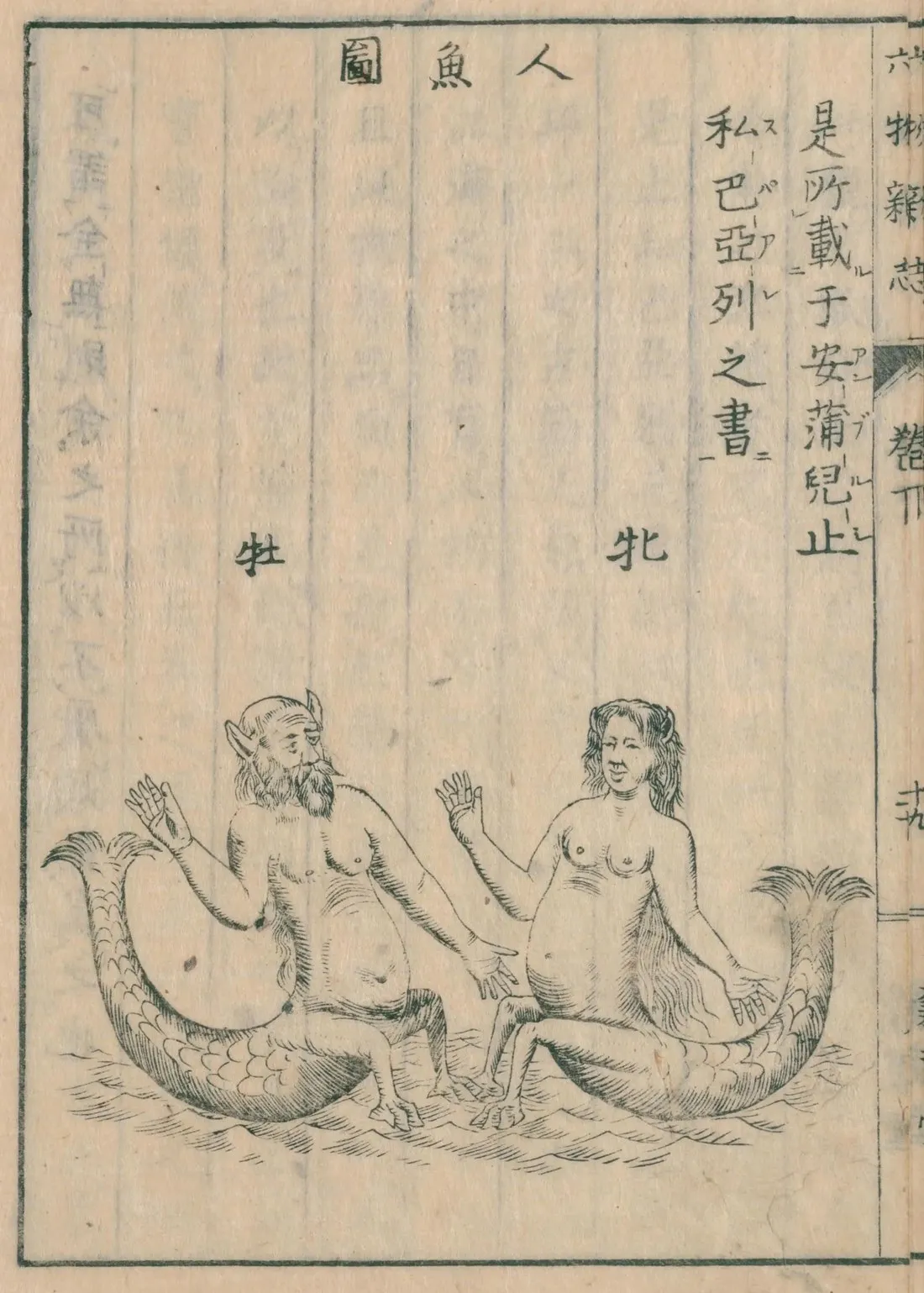
「六物新志」 (Rokumotsu shinshi), Ōtsuki Gentaku, preface dated 1786, the plate 人魚圖 (“picture of mermaids”) with a male (牡) and a female (牝), cropped. National Diet Library Digital Collections, call number 特1-104, pid 2555433.
What a visitor was promised survives on a handbill. The Hokkaido Museum holds the printed pitch for a mermaid show, which it dates to 1836 although the text is signed Tenpō 10, 1839.25 The pitch tells of an Ezo fisherman who caught the mermaid and dried it, and of a man of Noto who acquired it by trade and meant to give it to a shrine.25 It ends with a promise:
一たび閲する時ハ、第一長寿にして、福徳を増長し、疫病をうつらずと25
whoever looks at it once will, above all, live long, gain in good fortune and not catch epidemic disease
The museum calls such promises a stock phrase of Edo shows.25 Kinoshita Hiroshi told KSB that mermaid legends often involve immortality and that the mummies were believed to have medicinal uses.26 Nippon.com calls the story of Yao Bikuni the most widely told mermaid tradition in Japan: a girl in Wakasa eats mermaid flesh and stays young for 800 years as a nun.27 Kinoshita also told Nippon.com that such mummies were probably made from the late Edo period into the early Meiji period, with skilled craftsmen involved.28
On our reading, the handbill and the Enjuin paper tell a story of the same shape: a fisherman, a catch and a chain of owners.625 The handbill’s own dates do not agree.25
Who keeps it
The interim report announced a showing at the Kurashiki Museum of Natural History from 16 July to 25 September 2022, and the final report thanks the head priest for making the study possible.1329 Kato Takashi said, as Bunshun Online reported it, that the aim was to help preserve the mummy so local people could keep caring for it.30
The head priest told KSB that the thoughts of the first maker and of the many people who kept it live in the mermaid, that his first duty is to protect it and pass it on, and that it will stay at the temple.31
What we could not verify
Seen only where others quote them
- The box paper. We know its text only as the final report quotes it on page 6. It would show who wrote it and when, and whether the 1906 sale is in the same hand; the report does not reproduce it.
- The handbill. We read its text only as the Hokkaido Museum prints it. The museum gives 1836 and the text is signed 1839; the handbill itself, which would settle it, appears only as a small image on the colouring sheet.
Questions we could not settle
- The radiocarbon laboratory, the number of scales measured, the calibrated range and the error. The final report, the interim report and the press release give none of them, and we found no paper or repository record.
- How the mummy came to Enjuin, and who the Kojima and Komori of the paper were.
- When the paper was written.
- The temple’s own account of the mummy. We found no statement beyond the head priest’s remarks to KSB.
Read next
TaleŌtemachi, Tokyo, 940 to 2020
Masakado's head mound in Ōtemachi: a curse in print by 1926
TaleNasu, Tochigi, Japan, About 1400 to 2022
The killing stone of Nasu and a fox with two tails
TaleKyoto and Obama (Wakasa), Japan, 1449 to 1764
Yao Bikuni, the nun shown in Kyoto in 1449
Sources
- Final report, p. 4, 科学調査のまとめ: 「魚体部は、ニベ科の魚類の皮で覆われ、上半身は、布、紙、綿などの詰め物と漆喰様の物質を土台として、積層した紙とフグの皮でできており」; p. 2, ②1) 内部構造 for the animal hair and 「サルを連想させる形態となっているが、造形されたものである」
- KSB, 2023-02-07, section on materials: 上半身は綿や布にフグの皮と動物の毛を付けたもの、下半身は紙などを魚の皮で覆った作り物↑
- Final report, p. 5, 要約 ③: 「体毛には哺乳類の毛で、毛小皮(キューティクル)が観察できる。爪は動物の角質が使われている」
- Interim report, p. 1 and p. 2, ③: 体毛には哺乳類の毛と同じく毛小皮(キューティクル)が存在する
- Bunshun Online, 2022-04-22, the interim findings: hair shed from the mummy has cuticle like human and other mammal hair↑
- Final report, p. 2, ②1): 「上顎・下顎以外の、頭蓋骨、脊椎骨、肋骨などの主要な骨格がない」 and 「木や金属などの心材は使われておらず、主に複数種類の布、紙、綿などが使われている」; fig. 3 caption 「骨格は存在しない」↑
- Final report, p. 6, 歴史・民俗 ①: 「明治36(1906)年11月に小島氏から小森豊治郎氏に売り渡した」, then 「これらの具体的な人名などについて、確証のある情報は得られなかった」 and 「円珠院の人魚に直接繋がる情報は得られていなかった」↑
- KSB Setonaikai Broadcasting, 2022-02-02, body: the article states that how it came to the temple is unknown (paraphrase of the page as read)
- Nippon.com (Itakura 2022), section "Analysis of a Mummy": how it reached Enju-in is unknown
- Final report, p. 6, 歴史・民俗 ①: nothing in the paper connects directly to the temple's mummy↑
- Final report, p. 6, 歴史・民俗の立場から ①: 「書付には、人魚は『元文年間(1736(元文元)年~1740(元文5)年)(徳川吉宗の治世で享保のあと)に、高知(土州)沖で漁網にかかったものが漁師によって、大阪に運ばれ、販売されていたものを、備後(備後)福山の小島直叙氏の先祖が買い求め、以後、小島家の家宝とした。」
- Nippon.com, "'Ningyo': Japanese Merfolk and Auspicious Mummies" (Kimie Itakura, 26 April 2022), section "Analysis of a Mummy" (ja: 書き付けによれば、元文年間(1736~41)の吉宗の時代に土佐の海で取れ、変わったものなので干物にして大阪に持っていった)
- KSB Setonaikai Broadcasting, 2022-02-02, body: the accompanying papers say that in the Edo period it was caught in a net in Kochi Prefecture↑
- Press release, p. 1, first paragraph: 岡山県浅口市にある円珠院が所蔵している「人魚のミイラ」
- KSB, 2022-02-02, first paragraphs: a temple in Asakuchi City, Okayama, and the university in Kurashiki↑
- Final report, p. 4, 科学調査のまとめ: 「1800年台後半ごろのものと推測される」; also ③ 年代測定 and p. 5 要約 ④
- KSB, 2023-02-07, section on dating: 制作時期は1800年代後半の可能性が高い↑
- Final report, p. 4, ③ 年代測定: 「14C-AMS専用装置にて剥離した人魚のミイラのウロコの放射性年代測定を実施した。制作年代は1800年代後半の可能性が高い。」; p. 7 用語 explains the method↑
- Final report, p. 6, 歴史・民俗の立場から ①, whole paragraph (no date of writing, ink, paper or hand is given)↑
- Press release, p. 2, ■ 人魚のミイラについて, last paragraph: 『人魚干物』と書かれた書きつけと共にきわめて良好な状態で保管されており、体長は30cmほど
- KSB, 2022-02-02, physical description and accompanying papers bearing 人魚干物
- Nippon.com (Itakura 2022), section "Analysis of a Mummy" (box note 人魚干物; about 30 cm)↑
- Final report, p. 1, opening paragraph: 「調査は2022年2月2日に開始し」
- Press release, p. 1, first paragraph and the dated list on p. 2 (2022年2月2日 本プロジェクト開始)
- KSB, 2022-02-02, body: the mummy was brought to the university on 2 February 2022 and a research team formed↑
- Final report, p. 7, 謝辞 (the study could not have gone ahead without his cooperation)
- Nippon.com (Itakura 2022), section "Analysis of a Mummy": the abbot attended the X-ray CT scan↑
- Final report, p. 7, signature block 圓珠院所蔵『人魚のミイラ』研究チーム
- Press release, p. 2, 当プロジェクトの詳細と沿革: 化石哺乳類の専門家である加藤敬史教授が上半身、魚類学を専門とする山野ひとみ准教授が魚体部…、武光浩史准教授が剥離物のDNA分析↑
- Interim report, p. 1, 【これまでにわかったこと】
- KSB, 2022-04-25, interim findings: the teeth are completely unlike those of known primates and resemble carnivorous fish or reptiles; arm scales differ in shape from body scales
- Nippon.com (Itakura 2022), section "Analysis of a Mummy": interim report, primate-like features, teeth of a meat-eating fish↑
- Press release, p. 2, dated list under 当プロジェクトの詳細と沿革
- Final report, p. 7, signature block: 2023.2.7
- KSB, 2023-02-07, headline and first paragraph: about one year of research reported (published 2023/2/7)↑
- Final report, p. 2, ②1): 「各鰭の形、鰭条を構成する棘と軟条の数および鱗の形態から、魚体部はニベ科魚類の特徴を有する」; p. 5 要約 ①: 「肉食性の魚類の顎で、種類は明らかではない」↑
- Final report, p. 2, ②1): 「首の内部には直径1.2mm長さ13.0mmの針…背ビレには直径1.4mm、長さ31.6mmの針がある。背ビレに刺さる針の一部は外部からも観察できる」; p. 5 要約 ② also gives the lower body
- Interim report, p. 1, 【これまでにわかったこと】: 首と背ビレには金属製の針が刺さっている
- Bunshun Online (FNN Prime Online), 2022-04-22, the interim findings: CT showed metal needles in the neck and in the dorsal fin↑
- Final report, p. 1, ① 表面観察: 「体表には木炭粉と砂を混ぜた膠(にかわ)様のものが塗られている」; p. 5 要約 ①↑
- Final report, p. 4, ④ 皮膚片の化学成分分析 and ⑤ DNA分析: 「DNAを検出できなかった」; 「亜砒酸、硫酸クロム、ミョウバンなどの薬品は使われていない」↑
- Final report, p. 7, ②: 「大英博物館・ライデン国立民族学博物館など外国にも日本製と思われる人魚が存在する。→江戸期以降、多くの人魚が作製され、外国や国内に存在(流通)していた」
- Hokkaido Museum (北海道博物館), 「江戸時代の人魚の絵にぬりえしよう!」, p. 1, left column: 江戸時代おわりごろから明治時代にかけて、日本国内では数多くの「人魚のミイラ」が作られ、欧米に輸出された
- Nippon.com (Itakura 2022), section "Beyond Japan's Borders": the Leiden mummy was brought home by a Dejima Dutchman in the early 1800s; Barnum's 1842 mermaid was probably Japanese-made↑
- Final report, p. 7, ② 日本に現存する人魚ミイラについて↑
- Press release, p. 2, ■ 人魚のミイラについて↑
- Hokkaido Museum (北海道博物館), 「江戸時代の人魚の絵にぬりえしよう!」, p. 1, left column, last paragraph↑
- Hokkaido Museum (北海道博物館), 「江戸時代の人魚の絵にぬりえしよう!」, ; p. 1, 解説 and the boxed 原文/現代語訳; p. 2, 口上の原文; credit line: 「人魚の図」(1836(天保7)年刊/木版)[北海道博物館蔵弥永コレクション] transcription↑
- KSB, 2022-02-02, folklore paragraph↑
- Nippon.com (Itakura 2022), section "Youthful for 800 Years" (ja: 日本で最も広く伝わる人魚伝承は、「八百比丘尼」の物語だ)↑
- Nippon.com (Itakura 2022), section "Analysis of a Mummy"↑
- Interim report, p. 2, 【人魚のミイラの一般公開について】: 第31回特別展「倉敷動物妖怪展 at 自然史博物館(仮称)」、会期:7月16日(土)~9月25日(日) (announced as planned; the museum's own page was not opened)↑
- Bunshun Online (FNN Prime Online), 2022-04-22, closing paragraphs on the project's aim↑
- KSB, 2023-02-07, priest's statement (quoted in Japanese: 「初めに作った人の思いや、それを受け継ぎ保存してきたいろんな方の思いがこの人魚には宿っている。私自身はそれをまた守り、後々にそれを伝えていくことが一番」) and last line↑
Documents quoted
- Handbill for a mermaid show, kōjō (spoken pitch), signed Tenpō 10 (1839), Hokkaido Museum, Yanaga collection (transcribed from the page image)