 Twice Told
Ramanenjana, the dancing sickness of Madagascar, 1863
In 1863 the court physician called the dancers of Antananarivo a real illness; the missionary beside the king called it pure deception.
Contents
Published 5 Oct 2026. Sources checked 5 Oct 2026.
Two Britons watched the same crowds in Antananarivo in the spring of 1863 and reached opposite verdicts. Andrew Davidson, a Scottish doctor who titled himself physician to the court of Madagascar, wrote that no one who saw the dancers “can doubt that it was perfectly real as a psychopathy”.310 William Ellis, the London Missionary Society’s envoy, who read the Bible with the king, wrote that the sickness “had previously been shown to be pure deception”.411 Both appeared in print in 1867. Ellis says the dancers vanished from the capital when King Radama II was killed on 12 May 1863, and a Catholic mission’s memorial agrees.212
The accounts we could read were written by European missionaries, Protestant and Catholic, by a Malagasy doctor in 1902, and by Malagasy tellers whose words a compiler named Callet printed in 1908.61 None was written by a dancer.
This is the story as the Malagasy tellers in Callet’s collection and Father Finaz’s memorial, kept at the time, told it. Dance companies today keep its outline.913
When Queen Ranavalona I died she went up to Ambondrombe, the mountain of the dead, and the dead there welcomed her with cannon and music for more than half a month. Then palace servants who had died after her came with news that her son Radama II and the people of Antananarivo were praying. She was furious. Her dead husband Radama I tried to block the road and set the forest alight, and he could not stop her. She set out for the capital by night, and when her followers sagged under her baggage she ordered them to take living people as porters.1
At the first village the shades passed their loads to the living. Those who took one felt a violent headache, then saw the queen’s followers around them, and danced for a day or two.1 On 26 March the news went round that her shade had entered her old capital, and by evening the dancers were in the streets.14 They said they carried her trunk, her key, her sabre, and demanded the salute due to her belongings.1 On Palm Sunday they cut sugar cane and piled it on the sacred stone at Mahamasina, where Radama II had been crowned, as a gift to his mother.15 They told the king that she wanted the praying stopped, the whites sent away and the pigs kept out of the city.1 The king ordered his people to bare their heads to the dancers.16
In May officers and nobles killed the king, and the next day not one dancer could be found.212 A dance company’s page today puts it in a line: more than 20,000 people danced from February to May, and the “epidemic” stopped as the political regime changed.917
That is where the tellings end.
The writers
Six printed texts carry most of what follows, and they were written for different readers.
| In print | Text | By | Language |
|---|---|---|---|
| September 1864 | Annales de la propagation de la foi, vol. 3618 | A Catholic missionary of the Antananarivo mission, not named on the pages read | French |
| 1866 | Letter of 26 May 1863 from Ellis to General Johnstone, in Oliver’s Madagascar and the Malagasy16 | William Ellis | English |
| August 1867 | Choreomania, an historical sketch14 | Andrew Davidson | English |
| 1867 | Madagascar Revisited1 | William Ellis | English |
| 1870 | Madagascar and its People19 | James Sibree | English |
| 1908 | Tantara ny Andriana eto Madagascar1 | Malagasy tellers, compiled by François Callet | Malagasy |
Davidson, a medical missionary, reached Antananarivo in August 1862.10 The Annales passage speaks of “nos Pères”, our Fathers, and the Catholic mission at Antananarivo was staffed by Jesuits.20 A Jesuit history of 1885 says its own chapter on the Ramanenjana follows the memorial Father Finaz wrote at the time.21 Ellis and Sibree belonged to the same Protestant society as Davidson, and Sibree cites Ellis, so on the question of staging they count once.19 Callet’s pages give no teller and no date.
The dancers were mostly young women and slaves, and Davidson and Ellis both say Christians were not among them.22 Ellis put that point to the king as an argument that the visitation was not from his ancestors.22 The Annales says the illness “frappe spécialement les esclaves”, yet spares no one.22
March to May 1863
Davidson dates the first rumours to February 1863, from the west or south-west. In March pairs and threes were dancing in public places with musicians, and within a few weeks there were hundreds.14 The Jesuit memorial puts the news in the capital on 12 March and the dancers’ entry on 26 March.14 The Annales has them arriving a few days before Palm Sunday, which in 1863 fell on 29 March.15
A letter quoted in the Annales estimates “plus de deux mille” convulsionnaires camped on the Mahamasina plain below the city, and says that on the Tuesday of Holy Week, by our reckoning 31 March, more than a thousand soldiers broke ranks at a review and began to dance.8
Ellis, by his own account, first told the king the sickness would end like other epidemics at the close of the rains. After two or three weeks he saw few cases, and then in April came reports that it was back with more violence, with dancers said to be paid to come into the city.23 Near a building site on the Faravohitra road he watched a young woman dance along the path. He did not think she was ill: “she certainly knew what she was about”.24 On another occasion, while he was photographing the site of the martyrs’ deaths at Ambohipotsy, a young woman in a light-blue scarf danced round his camera, “more like a damsel dancing for pleasure, than the unconscious subject of disease”.24
Ellis reports that the king told him fresh tidings said his ancestors were coming with cannon, muskets and swords, and that the bearers of such reports brought the king presents they said the ancestors had told them to bring.25 Radama issued the order that people uncover their heads to the afflicted, with a fine for refusing.16 The Annales gives the fine as 150 francs and says most whites went bareheaded.16
In early May, Ellis was reading with the king when dancers, drummers and the keepers of the idols burst in. He writes that friends told him afterwards the visit had been planned as the occasion to kill him, and does not vouch for it.26 On 7 May the king announced an order that anyone might settle a quarrel by arms without punishment, and the nobles protested.27 Just after cock-crow on 12 May, as it was reported to Ellis, a party of officers and soldiers went to the house where the king had spent the night.12 Ellis says the king was strangled with a twisted girdle, and that the public announcement the next day said he had put an end to his own life.28
“Dès ce moment, les Ramanenjana disparurent,” writes the Jesuit memorial: the next day none could be met in the town or the countryside.2 Ellis says the same, and adds that he saw soldiers who had brought the sickness with them leap from the ranks and be brought back, and that an order to arrest them was enough to end it.2
What the dancers asked for
Each of the three main accounts lists things the dancers could not bear, and the lists do not quite match.
| Detail | Annales 1864 | Ellis 1867 | Davidson 1867 |
|---|---|---|---|
| The queen’s message | Stop praying, send the whites away, no pigs1 | Angry at the praying and the swine1 | Many spoke with the late queen1 |
| Hats | Hats off, 150 francs fine16 | Hats off, fine16 | Disliked above all things29 |
| Pigs | Named in the message1 | “Great aversion”29 | Disliked above all things29 |
| Black clothes | A priest’s cassock29 | Not mentioned | Dislike of “every article of dress of a black colour”29 |
| Sugar cane | From Palm Sunday, to the stone15 | Laid on the stone daily15 | Placed on the stone15 |
| Bottle of water | Balanced on the head30 | Carried by friends, for thirst31 | Balanced on the head30 |
Davidson found the dislike of black “so common in this disease, in all its recorded epidemics, as to deserve attention”, and notes it in the child pilgrimages of the thirteenth century.29 Of the pigs and hats he gives the plain reading: “Swine are reckoned unclean by several tribes in Madagascar”, and hats might be resented as foreign.29
The Jesuit memorial names the dancers’ cry. “Maika” means pressed, and the crowds called them Ramaika; the Annales prints their usual shout as “izahay maikia”, “nous sommes pressés”.32 Callet’s Malagasy pages print the song the singers repeat:
Izahay maikia e e e!32
We are in a hurry!
The name Ramanenjana itself comes from a root for tense or stiff.18
A real illness or a staged one
Davidson wrote as a physician comparing the dancers with the choreomania of medieval Europe, and the dancers fitted. He says the afflicted complained first of a weight at the chest and stiffness at the neck, grew restless, then could not resist music.33 On whether it was real he is blunt, and he also allows for fraud:
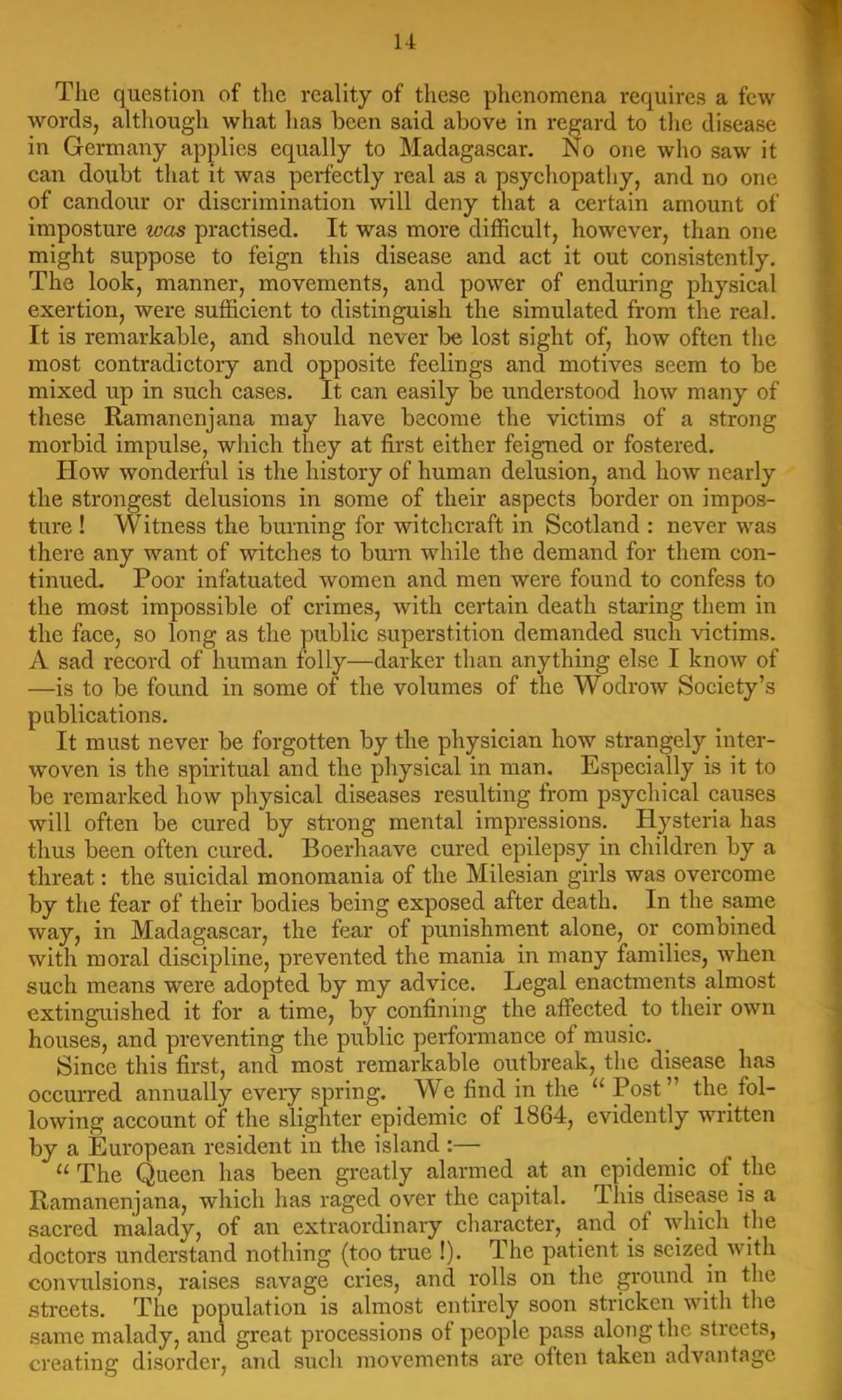
Andrew Davidson, Choreomania, an historical sketch (Edinburgh, 1867), p. 14. Wellcome Collection, Public Domain Mark.3
He grants “a certain amount of imposture” and thinks it hard to fake the look, the movements and the endurance. He supposes many of the dancers “at first either feigned or fostered” a strong impulse and then fell into it.3 The political excitement, he writes, supplied a condition for the epidemic and did not cause it, and it spread by what he calls “pathological sympathy”.34 Yet he also writes that the mania “in no small degree, tended to bring about the rebellion, which ended in the death of the sovereign and his ministers”.35 A newspaper account of 1864 that he quotes and calls exaggerated goes further: “The unfortunate Radama was a victim of the Ramanenjana of 1863.”36
Ellis went the other way. He had told the king that “the sickness, so far as it was real, presented nothing unaccountable”.4 He reads the dancers as pawns. Some, he writes, were really ill, and he offered them water and medicine, but he “looked upon them chiefly as the deluded victims of evil men”.4 By his account the men behind them were the keepers of the idols, who gathered the offerings of cane and money laid on the stone each evening and divided them.15 After the king’s death he writes that “it had previously been shown to be pure deception”.4 Sibree echoed him in 1870, writing that the dancing was “adroitly fomented and made use of” by the diviners.19
The Jesuit memorial agrees that there was a plot, and says the “comédie” gave itself away: the least clear-sighted guessed a design behind the popular agitation.37 On the nature of the sickness it reports a split among the doctors of 1863: some saw an ordinary morbid state, which they blamed on “exhalaisons du chanvre en fleurs”, the fumes of hemp in flower, while others saw a sickness in which fallen angels and human cunning were mixed.38
Ellis reports that the king sometimes said he could not understand it, and at other times that “some of it must be true”.11
The dancers’ own side
Respect for the ancestors shaped the sickness, Davidson saw: those who knew how the Malagasy honour their dead and their tombs might have predicted the form it took.39 The Jesuit memorial says the Malagasy have always treated people struck by this “mal sacré” with respect, and that its writer cannot tell the tromba, a possession long known in Madagascar under several names, from the Ramanenjana.40 Sibree, in 1889, called the dancing “a kind of Malagasy spiritualism”.41
Callet’s Malagasy tellers record what the dancers meant. They say the Ramanenjana made the Merina believe again that the spirits of the dead all go to Ambondrombe, and that under Radama II people said the affairs of the dead and the living would be mixed:
hifangaro ny raharaha ny maty sy ny velona42
the affairs of the dead and the living will become mixed
The same pages have the king’s order, in Radama’s reported words: if anyone obstructs the sick, he will hold them guilty, and the sick may take what they want.43 They also have a scene at the rova, the royal compound, in which a sick person demands entry:
Avelao aho hiditra, fa asain-dreny ny mankaty amy ny.43
Let me in, for his mother has sent me here to him.
Read as a teller’s story, not as a record of what was said at the door, it has the dead mother as the sender, as the Jesuit and English accounts do.1 The whole passage is on its own page.
What later scholars make of that is a different argument from Ellis’s. The French historian Françoise Raison-Jourde, as David Graeber reports her, called it “a kind of revolution through spectral theater”.5 Graeber builds on her. He reads the dancers as mostly women and slaves, who had the most to lose if Radama II’s plantation plans went ahead, and sees the sugar cane carried to the stone as a version of the cane carried in circumcision processions.44 He says the guardians of the sampy came out into the streets in support.45 Stephen Ellis, writing in 1985, calls the dance “a cry from the heart”, a way of restoring the ceremonies a king should perform.46 In our reading, none of these depends on whether the dancers were ill.
How many
The period record gives four numbers, and none of them is 20,000.4787
| Source | Figure | What it counts |
|---|---|---|
| Annales, 1864 | More than 2,000 | Convulsionnaires camped at Mahamasina8 |
| Annales, 1864 | More than 1,000 | Soldiers who left the ranks at one review8 |
| Annales, 1864 | More than 200,000 | Men who witnessed the Ramanenjana47 |
| Davidson, 1867 | Hundreds | Dancers in the capital within weeks7 |
The 200,000 figure comes from the same text, on the page before the letter that estimates 2,000. A Jesuit letter printed in a history of 1884 gives the whole town as sixty or seventy thousand people, so 200,000 witnesses cannot have been inhabitants.48 Two dance projects, the Tangaj Collective and the National Center for Dance Bucharest, each say that “more than 20,000 people danced with supernatural resistance from February to May”, and neither names a source.913 We could not trace the figure. The Annales page is on its own page.
Checking the telling
| The story | The record | Verdict |
|---|---|---|
| More than 20,000 danced9 | Hundreds, or over 2,00078 | Unsupported |
| The dancers said the dead queen sent them1 | All the accounts say so1 | Confirmed |
| They hated hats, pigs and black clothes29 | Davidson, Ellis and the Annales29 | Confirmed |
| Cane was laid on the coronation stone15 | Davidson, Ellis, the Annales and Callet15 | Confirmed |
| It stopped when the regime changed17 | Gone from the capital after 12 May2 | Confirmed |
| Mosquitoes may have spread it49 | Malaria argued in 19026 | Added later (1902) |
After May 1863
“Stopped” is true of the capital in May 1863 and not of the sickness. The dancers returned in March 1864, a year to the day after their first appearance, according to a Jesuit history of 1884; the prime minister forbade the chanting, the clapping and the gatherings at the sacred stone.50 Queen Rasoherina’s edict ordering anyone who claimed the sickness put in irons ended it, the 1885 memorial says: those who had only claimed it dropped away, and the ones really ill were kept hidden by relatives or masters.50 Davidson says it came back every spring.50 Stephen Ellis writes that order in Imerina was restored only in the middle of 1864.50 Sibree, reprinting Davidson in 1889, added that it still appeared in country places in early April, when the main rice crop ripens, and never among Christians, and that fuller information was needed on these customs and diseases.5141
A malaria thesis from Montpellier
The earliest Malagasy author we found on the subject is a doctor, Andrianjafy, who wrote a thesis for the Faculty of Medicine at Montpellier in 1902.6 He writes that in his search of French and foreign books he found only Davidson’s description and a lecture of 1865 by Boudin.52 His father, an old Malagasy practitioner, had watched the Ramanenjana for more than twenty years, and the thesis is built on his observations and the son’s.6 Andrianjafy argues that it was a pernicious, nervous form of malaria, with choreic movements shaped by superstitious fears and sorcery.6 The two dance projects list malaria among their explanations; neither says where the idea comes from.13
Davidson wrote that he never heard of the dancing itself proving fatal, though he knew of a few deaths among patients who were held back from it.53
What we could not verify
Sources we have not seen
- Raison (1976, ASEMI 7, pp. 271 to 293) and Raison-Jourde (1991, Bible et pouvoir à Madagascar au XIXe siècle). They would show how she documents the slaves’ part and the festival calendar. We found no digitised copy in Persée, HAL or the Internet Archive.
- Kélina Gotman, Choreomania: Dance and Disorder (Oxford, 2018), on Madagascar. It would give the current English-language reading. The publisher’s page refused access, and we found no copy we could read online.
- Maurice Bloch, From Blessing to Violence (1986), on the scale of the epidemic. The only online copy is lending-only and refused access.
Seen only where others quote them
- Raison-Jourde’s phrase and argument, which we know only as Graeber (2017) reports them.
- Boudin’s 1865 lecture on the epidemic choreas of Madagascar, which we know only as Andrianjafy (1902) cites it.
Resting on a single source
- The Annales’ figure of more than 200,000 witnesses, which no other text we read repeats.
- Ellis’s report that friends told him the dancers’ visit to the king’s house was planned to kill him.
- A Jesuit history’s claim that the London Missionary Society’s Mr Toy preached regicide in March 1863. No Protestant text we read says so.
Questions we could not settle
- Where the figure of 20,000 dancers comes from.
- Who wrote the Annales account, and when Callet’s tellers gave theirs.
Read next
TaleUasin Gishu and the Nandi forest, Kenya, 1909 to 1927
The Nandi bear and the devil called Chemosit
CaseBeijing, China, 1476 to 1477
Heisheng, Beijing's black creature of 1476, and the Western Depot
CaseHermersdorf (Svobodné Heřmanice), Czechia, 1753 to 1768
Hermersdorf's vampires were burned before Vienna sent a physician
Sources
- Davidson 1867, p. 12 (primary)
- William Ellis, Madagascar Revisited (London: John Murray, 1867), pp. 265 to 266 (primary)
- Annales 1864, pp. 403 to 404 (primary) transcription
- François Callet, Tantara ny Andriana eto Madagascar (Antananarivo: Académie malgache, 1908), from Malagasy manuscripts, p. 640 (primary) transcription
- de la Vaissière 1885; and Histoire de Madagascar, ses habitants et ses missionnaires, vol. 1 (Paris: Lecoffre, 1884), 1885 pp. 228 to 229 (OCR); 1884 p. 392 (OCR)↑
- Ellis 1867, pp. 313 to 314 (primary)
- de la Vaissière 1885, p. 232↑
- Davidson 1867, p. 14 (primary)↑
- Ellis 1867, pp. 267, 313 to 314 (primary)↑
- Graeber 2017, pp. 328 to 329↑
- Andrianjafy, Le Ramanenjana à Madagascar (choréomanie d'origine palustre), thèse de médecine (Montpellier, 1902), pp. 5 to 6, 13 to 14, 36 (OCR, unchecked)↑
- Davidson 1867, p. 10 (primary)↑
- Annales 1864, p. 403 (primary) transcription↑
- Yvette Ranjeva Rabetafika, "Davidson, Andrew", Dictionary of African Christian Biography (dacb.org), entry (1836 to 1918)
- Davidson 1867, title page (OCR) (primary)↑
- Ellis 1867, p. 266 (primary)↑
- Ellis 1867, p. 290 (OCR) (primary)
- de la Vaissière 1885, p. 231 (OCR)
- David Graeber, "The people as nursemaids of the king", in Graeber and Sahlins, On Kings (Chicago: HAU Books, 2017), ch. 5, p. 334 (OCR)↑
- Andrew Davidson, Choreomania, an historical sketch, with some account of an epidemic observed in Madagascar (Edinburgh: Oliver and Boyd, 1867; reprinted from the Edinburgh Medical Journal, August 1867), p. 10 (primary)
- P. de la Vaissière, Vingt ans à Madagascar (Paris: Lecoffre, 1885), following Father Finaz's memorial, pp. 229 to 230↑
- Davidson 1867, p. 12 (primary)
- Ellis 1867, pp. 267 to 268 (primary)
- Annales 1864, p. 405 (primary)
- Callet 1908, p. 641 (primary) transcription
- de la Vaissière 1885, p. 230
- de la Vaissière 1885, p. 230↑
- Ellis 1867, p. 267 (primary)
- Annales 1864, p. 406 (primary)
- Ellis's letter of 26 May 1863 to General Johnstone, printed in Samuel P. Oliver, Madagascar and the Malagasy (London, 1866), Appendix, note C, pp. 94 to 95 (OCR) (primary)↑
- Tangaj Collective, project page↑
- Sibree 1870, p. 448, checked against the page image (primary)↑
- de la Vaissière 1884, vol. 1, pp. 388 to 389 (OCR)↑
- de la Vaissière 1885, p. 228 (OCR)↑
- Davidson 1867, pp. 10 to 11 (primary)
- Oliver 1866 (Ellis's letter, 26 May 1863), p. 95 (OCR) (primary)
- Annales 1864, p. 405 (primary)
- Ellis 1867, p. 266 (primary)↑
- Ellis 1867, p. 265 (OCR) (primary)↑
- Ellis 1867, p. 259 (primary)↑
- Ellis 1867, pp. 264 to 266 (OCR; p. 266 read on the image) (primary)↑
- Ellis 1867, pp. 268 to 271 (primary)↑
- Ellis's letter of 26 May 1863 in Oliver 1866, pp. 95 to 96 (OCR) (primary)
- Ellis 1867, pp. 275 to 276 (OCR) (primary)
- Graeber 2017, p. 334 (OCR)↑
- Ellis 1867, pp. 300, 302 (OCR) (primary)
- James Sibree, Madagascar and its People (London: Religious Tract Society, 1870), p. 449 (OCR) (primary)↑
- Davidson 1867, p. 12 (primary)
- Ellis 1867, pp. 266 to 267 (primary)
- Annales 1864, p. 406 (primary)↑
- Davidson 1867, p. 12 (primary)
- Annales 1864, p. 406 (primary)
- Callet 1908, p. 642 (primary)↑
- Ellis 1867, p. 265 (OCR) (primary)↑
- Annales 1864, p. 404 (primary)
- de la Vaissière 1885, p. 230
- Callet 1908, p. 642 (primary)↑
- Davidson 1867, p. 11 (OCR) (primary)↑
- Davidson 1867, pp. 13, 15 (p. 15 read on the image; p. 13 OCR) (primary)↑
- Davidson 1867, p. 15 (primary)↑
- Davidson 1867, quoting "the Post", pp. 14 to 15 (primary)↑
- de la Vaissière 1885, pp. 230 to 231↑
- de la Vaissière 1885, p. 232↑
- Davidson 1867, p. 13 (OCR) (primary)↑
- de la Vaissière 1885, p. 232↑
- Antananarivo Annual no. 13 (1889), p. 27, checked against the page image (primary)↑
- Callet 1908, p. 640 (primary) transcription↑
- Callet 1908, p. 641 (primary) transcription↑
- Graeber 2017, pp. 329 to 334↑
- Graeber 2017, p. 334 (OCR)↑
- Stephen Ellis 1985, p. 15↑
- Annales 1864, p. 402 (primary) transcription↑
- de la Vaissière 1884, vol. 1, pp. 390 to 391 (OCR)↑
- Tangaj Collective, project page↑
- Davidson 1867, p. 14 (primary)
- de la Vaissière, Histoire de Madagascar, vol. 1 (1884), p. 416 (OCR)
- de la Vaissière 1885, p. 232
- Stephen Ellis, The Rising of the Red Shawls (Cambridge University Press, 1985), p. 15↑
- Antananarivo Annual and Madagascar Magazine, no. 13 (Christmas 1889), Addendum to Davidson, p. 27, checked against the page image (primary)↑
- Andrianjafy 1902, pp. 5 to 6 (OCR)↑
- Davidson 1867, p. 13 (OCR) (primary)↑
Documents quoted
- Annales de la propagation de la foi, 1864: the Jesuit account of the Ramanenjana (transcribed from the page image)
- Callet, Tantara ny Andriana, 1908: the Ramanenjana at the palace (OCR, checked against the page image)